If you haven´t seen this, or haven´t posted your story, you should see the site. It´s incredibly moving: http://wearethe99percent.tumblr.com/archive.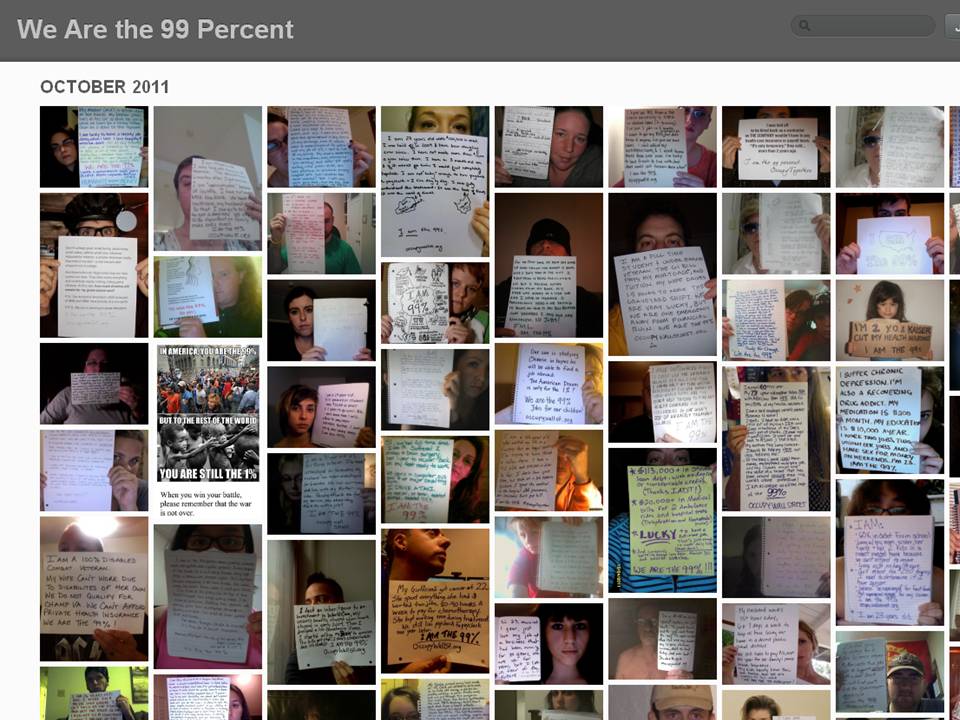
gianpaolo baiocchi
sociology, broadly conceived
-
-
A super cool discussion with Josh Cohen on OWS, at Occupy the Airwaves. A very thoughtful set of reflections on a Rawlsian theory of Justice and unfolding events.
-
This is a very interesting interview that has just been published in English and Spanish by El País. D’Arcais is a very progressive Italian philosopher whose writings rarely reach English-speaking audiences, and who edits a journal called Micromega.
The original article is here.
“Politics has become a profession”
JOSÉ MARÍA RIDAO – Rome – 07/11/2011
Through his public statements against Silvio Berlusconi’s policies and the reflection that he stimulates in his magazine Micromega, Paolo Flores d’Arcais has become one of the most influential intellectuals in Europe. Born in Udine in 1944, Flores d’Arcais focuses on the Italian political experience, especially regarding the role of parties, the separation of powers and the influence of the media. But he always seeks to go beyond his own country, perhaps because Italy has begun to look like either a warning of what could happen in other countries, or as a symptom of what might happen if nothing is done to fix it.
Question. On November 20, the Spanish people will go to the polls in an environment of growing distrust towards politicians.Answer. Distrust of politics and distrust of professional politicians and party apparatuses are two different things In Italy, civil society has mobilized, emphasizing precisely that distinction, with demonstrations like the one that took place on San Giovanni square which was organized, so to speak, by a group of friends, including [filmmaker] Nanni Moretti and myself.
Q. What do all these movements ? including the “indignant ones” ? have in common?
A. They are movements that want more politics, not less politics. But at the same time, they express a total disdain for official politics, which has become a profession. What we’re seeing is a crisis of traditional parties that has been brewing for the last three decades.
Q. And what was the origin?
A. Parties started getting more and more self-referential and falling into the hands of professional politicians; people who don’t do any other kind of work in their entire lives. Their priority is their own career, not representing citizens.
Q. And that ends up erasing the differences between the opinions that the parties represent.
A. Thirty years ago I wrote an essay about this phenomenon, in which I resorted to a French expression. The opposing parties are, shall we say, Bonnet Blanc, on the one hand, and Blanc Bonnet, on the other. Since then, the response has always been, contrary to what I said, that there may be cases that show the opposite in France or in Spain, but Italy is a special case.
Q. Can there be representation if there is no difference between the options?
A. They say that direct democracy is a utopia, and at the same time, that we’re the creators of representative democracy. But then they say that citizens’ desire to feel represented is excessive. When the differences between parties are analyzed, the focus is usually on their election manifestos, never on the party itself as an instrument. They are machines driven by cooptation, which leads the most mediocre individuals to be selected. Because only those who enter that machine at a young age, and agree to compete with its logic, can hope to have a career. That logic excludes, from the get-go, all citizens who might participate in active politics, but not on a professional basis.
Q. These discourses against parties and professional politicians… mightn’t they fuel a new anti-parliamentarianism?
A. If reforms are not made, in order to make parliamentary democracy representative again ? at least somewhat ? then the response of many citizens will be that parliament and democracy are totally different things. Avoiding the risk of anti-parliamentarianism means totally reinventing parliamentarianism. To do this, countless measures need to be taken, from reforming electoral laws to implementing mechanisms to keep politics from becoming a profession.
Q. You really insist on that last point.
A. It would suffice to pass a law that politicians can’t stay in office for more than two terms. You often hear professional politicians say that if they worked in the private sector they would be better off, and that everything they do is in the spirit of public service. Well, then, let’s take all that rhetoric seriously; the rhetoric of politics as the spirit of service. Doing politics, representing others and governing should be a public service, a sacrifice that might last five or 10 years, no more. Let’s make sure that there aren’t citizens who sacrifice too much.
Q. Then there’s the problem of financing.
A. Not only party financing, though, but the financing of politics. I organized a demonstration with Nanni Moretti, and if we had wanted to transform its power into an election manifesto, it would have been impossible. We wouldn’t have gotten even one percent of the votes. We weren’t organized all over the country like traditional parties, and we didn’t have any media space. To put together a public debate, in a theater for example, we would have had to raise money. We need to make it easier for all individuals to enter institutional politics, offering free organizational and communication tools, while making it more difficult for professional politicians to remain in power in a monopolistic way.
Q. All individuals?
A. Marx criticized representative democracy because he only saw the abstract citizen in it, without taking into account specific situations such as the citizen’s status as a property owner or a member of the proletariat. This, which was a criticism, is something that we need to accept as a model. Come election time, only the abstract citizen should vote. There should be a clear, total separation between economic interests and political power.
Q. And how would you achieve that separation?
A. All the colors that want to participate in politics should be financed in an equal, free way. But financed in services […], not in money. Money only serves to keep bureaucratic apparatuses running. If all colors, all movements and all candidate slates had free access to communication tools, now that would be a major change.
Q. Parties often give different answers to the same agendas, but the agenda itself isn’t questioned.
A. I don’t mean to undervalue the differences. The Spanish right takes to the street with their crosses and it’s got its positions about abortion and other issues, and Zapatero has made some of the most cutting-edge decisions in Europe. But some crucial questions are avoided by both the right and the left. In hyper-mediatized politics, you’ve got no choice but to send out optimistic messages. And that’s done at the expense of denying problems.
Q. What might those problems be?
A. Inequality, a fundamental issue: that’s the problem, even from the standpoint of efficiency. But no leftwing party seems to have accepted it clearly.
Q. When a leftwing party loses an election, they say that the left is in crisis. You never hear that when a rightwing party does.
A. It’s true, it seems that the right loses the election but doesn’t go into crisis. But it doesn’t go into crisis because, even though it’s not in control of the government, it still has the power. All leftwing European parties say they are reformist. But you can’t talk about true reformism if the relations between power and wealth don’t change. Years ago, I was asked about the crisis of the left. What left? I said. Citizens can only choose between two rights, and it’s only normal that they prefer the real one.
Q. The polls say that the Right is going to win in Spain. If this does in fact occur, what will it mean for Europe?
A. The crisis that we’re going through now can’t be solved just with more Europe, as they say, but with more radically democratic Europe. It’s not enough to have a European government to fight the crisis; it’s got to be a government capable of reversing the trend toward inequality, which reinstates and reinforces the welfare state. Rightwing governments don’t take on that objective.
Q. Then you’re not optimistic about the future of Europe?
A. It’s not a question of optimism or pessimism, because we’re talking about sensations that can change from one day to another. We’re suffering from a financial, economic and social crisis. That third aspect, the social one, is the one that has been taken into consideration the least, yet it’s key to pulling out of this. There are no parties that accept that logic, although the leftwing parties should be the ones to do so. But they really aren’t leftist anymore, because they’re in the hands of self-referential machines designed to make political careers. It’s true that, in some cases, the left differs from the right in small things, which allows citizens to choose between bad and worse, or even between worse and even worse. There is, however, a vehement desire for change. Sometimes it takes the form of rage, other times enthusiasm or indignation… even despair.
-
Today and tomorrow there is a very interesting workshop at IESA, in Cordoba, Spain, one of the first institutes in Europe to dedicate itself to research on participatory institutions. There has been no lack of interest in the study of participation, and the conference takes stock of the last ten years or so of research in the area. Turns out this area of research is very plural, with presentations from topics as varied as Experimental Design, ethnography, survey, and a variety of comparative approaches in between. The program is online, as will be some of the presentations.
-
This comes from via my friend Zeynep Gambetti, from Bogazici University, in Istanbul. Please consider signing the petition below.
Urgent Appeal: Stop Arbitrary Detentions in Turkey!
The international public has so far been oblivious to the so-called “KCK operations” carried out in Turkey by Prime Minister Erdogan and his Justice and Development Party for the past two years. Under the guise of “fighting terrorism,” the Erdogan government has been using the judiciary, the police, and the media to penalize all civic activism in support of rights demanded by Kurdish citizens in Turkey. The “KCK operations” in particular have been deployed to spread fear amongst activists, to silence public dissent, and to normalize the arbitrary arrest of citizens. Ironically, the Erdogan government’s suppression of dissent and of democratic politics has visibly intensified at a time when “Turkish democracy” is being hailed as a model for the Arab world.
Since 2009, as many as 7748 people have been taken under custody on the alleged grounds that they are associated with the KCK—an organization claimed to be the urban branch of the armed organization known as the PKK (Kurdistan Workers’ Party)—while 3895 people have been arrested and imprisoned without even the prospect of a trial in the foreseeable future. Elected mayors, public intellectuals, members of civic associations, journalists, university students, researchers, academics, and activists have all been undergoing this heavy-handed treatment.
One of the latest victims of the Erdogan government’s assault on public dissent is Professor Busra Ersanli of Marmara University, a highly respected academic. Her only apparent “crime” is to have played an active role within BDP (Peace and Democracy Party), which has been struggling for the rights of Kurdish citizens in Turkey. The members of this party have been systematically targeted by counterterrorism units’ arbitrary arrests, even as the party currently holds seats in the parliament. Professor Ersanli was to attend a conference on “Controversial Issues in the History of the Turkish Republic” at Istanbul Bilgi University on 29 October 2011, but she was taken under custody on 28 October. On the same day, Ragıp Zarakolu—a founding member of the Human Rights Association and the former chair of the “Writers in Prison Committee” of the International PEN organization in Turkey—was also taken under custody within the framework of the “KCK operations.”
Earlier in October 2011, Ayse Berktay (Hacimirzaoglu)—a renowned translator, researcher, and global peace and justice activist—was taken by the police from her home in Istanbul five o’clock in the morning and subsequently arrested. She still remains imprisoned for the foreseeable future. Professor Busra Ersanli, Ragip Zarakolu, and Ayse Berktay are among thousands of people who have been imprisoned and silenced in the last two years.
Under such political conditions that are only getting worse, it has become an urgent task to unmask the arbitrary and authoritarian character of the Turkish government’s handling of the Kurdish issue. We are calling on friends abroad to spread the news and to build international pressure, which has become especially crucial and urgent at this time when any citizen of Turkey could be targeted by the Erdogan government, the judiciary, and the police for engaging in political acts of solidarity with those detained under the “KCK operations.”
Peace can never be achieved under the current conditions of public fear, paranoia, and authoritarian politics. Please sign the petition below to put pressure on the Turkish government to immediately release all those who have been taken under custody as part of the “KCK operations” and to demand that Prime Minister Erdogan’s government make a sincere commitment to ending its suppression of civic efforts in support of rights demanded by Kurdish citizens in Turkey.
-
El País, one of the Spanish newspapers of record, ran a headline on October 16th, that the Indignado movement had spread all over the world. This is, of course, a Spanish take on things. As important as the acampados in Madrid have been in sparking the flame, Occupy also has its own roots: adbusters, Madison, disappointments with a certain occupant of the White House, and others. One of the interesting things to think about as 15O/Occupy builds up momentum in the United States is the way that different strands come together to animate people´s imaginations. As my friend Michael Kennedy has said, how we think of the movement’s origins is now still an open question that has to do with what the movement will become and understand itself.
In that spirit, it is worth it, for me, to think back about 10-11 years and the shifting topography of global social justice. Back in 1999 there were the Genoa/Seattle protests and some of the contemporary moments that marked what would become known, for many, and despite efforts otherwise, as the “anti-globalization movement.” I remember a lot of the discussions that ensued after Seattle: the possibilities of “turtles and teamsters” alliances, how to think of this new moment (movement? movements?) the less-than-diverse composition of some of the crowd in Seattle and the role that people of color would play in its leadership, for example. But one of the important debates had to do with proposals. If the movement was against corporate globalization, what did it stand FOR?
The story from then on is well-known, but global social justice then became a largely Franco-Brazilian co-production. Attac, Abong, and a few other Brazilian organizations helped kick off the World Social Forums, held in Porto Alegre for the first years. The Forums were very much about proposals. Lots and lots of them. Though the decision was taken after the first year to disallow participation of representatives of political parties or by elected officials, political parties were always present in some way. Of course, the sympathetic PT administration in the municipality and state made things possible. But Petistas, Chavistas, the Fourth International, French Socialists, the forum of progressive elected officials, Cuban government officials, were all in some ways always there. I thought that this was not a bad thing, and I wrote in 2004 that these groups, and principally the PT, respected the autonomy of the Forum. The important thing was the productive tension between Forum spaces and party activity.
One of the interesting things of the recent global wave of events has been that the center of gravity has been Spanish and US American. The mobilizations in both France and Brazil have been very muted, if not absent. I know less about France, but the argument, at least according to some editorials in Le Figaro and Le Monde (and thanks to Ernesto Ganuza for pointing this out), is that the primaries within the Socialist party give voice to those who would be indignados.
And in Brazil, despite an internet campaign ahead of time, the acampamentos in Brazil have been small. There is one occupation in Sao Paulo, one in Cinelandia in Rio de Janeiro, and a half dozen other even smaller ones throughout the country You can follow them here. On one hand it is nice to see, for once, that the United States is in the news for something positive, but on the other this is curious – Brazil, the country of superlatives when it comes to social justice (the largest democratic leftist party in the world, the largest social movement in the world, the largest labor federation in the world, the supersized social forums, the fastest redistribution of income in a democracy etc.) is essentially not part of an incredibly significant global movement. Why is this?
Part of the answer is that Brazilians have been doing well, better than probably in any time in recent memory. A poor Brazilian today likely has better access to health services than a poor American. Unemployment is low, and we have talk of upward mobility for the first time in generations. Access to higher education has wildly expanded in the last eight years, and dire poverty has essentially disappeared thanks to cash transfer programs.
But at the same time Brazil does not lack for causes of indignation. Landlessness continues to be a problem. Violence and social exclusion still define urban spaces. Racial inclusion has a long long way to go. Police abuses are still the order of the day in many, if not most, favelas. And urban improvements in favelas for the olympic games/world cup currently threaten to go the way of South Africa (ie. urban cleansing). And by no stretch of the imagination are lives of Brazilians not impacted by global financial markets. The Brazilian government has continued a policy of political economy orthodoxy – running budget surpluses and making debt repayments, which as many have argued over the last eight years, takes money out of social programs and puts them in the coffers of international banks to service debts partially accrued during a dictatorship. And whatever one´s position on the events of the last years with the Workers´Party, corruption still exists in all levels of government in Brazil. In other words, many of the banners of the Indignados of Plaza del Sol or on Wall Street could just as easily be adopted in Sao Paulo or Rio.
For me, those who would be Indignados of Brazil have simply too many other places to voice their opinion. On the ¨Democracia Real Brasil” page someone posted a satirical “Shut up Brazil” card, implying that all of the social programs have come at the cost of the people´s voice: in exchange for social benefits, the poor have decided to be quiet. I think it´s quite the other way around. I think people have had lots of opportunity for voice. In some writing related to a project with my friend Ana Claudia Teixeira (in which Luciana Tatagiba, Lizandra Serafim, Evelina Dagnino and Rebecca Abers also participate), we relay some of figures from the last 8 years of participatory efforts under Lula in Brazil.
In addition to the thousands of local instances to participate (in health councils, participatory budgets, etc.), the government sponsored a tremendous number of national spaces of dialogue in terms of standing councils, like the national council on health (an institution to mediate dialogue between government and society on the topic), and conferences, like the national conference on human rights (a nation-wide meeting in Brasilia with representatives from civil society from all states). By 2010 there were 68 distinct national councils in operation in Brazil; and during the Lula years there were 74 national conferences on 40 different topics, 28 of which were recognized by the government for the first time. These conferences mobilized over three million people, who came up with over 14,000 proposals and approved 1,100 motions. Youth conferences mobilized an additional 5 million people. That’s a lot of places to voice your opinion! Some have been critical of the limits of participatory conferences (as Ana Claudia and I have been in our essay), but it´s undeniable it has been a policy of recognition of many unrecognized voices.
In fact, some indignado themes have been subject of conferences, including corruption. While people all over the world were preparing for the mobilization of October 15th, in Brazil, the National Conference on Transparency and Participation was moving through its preparatory stages. After months of meetings in most cities, delegates from all over the country are now going to be chosen to defend proposals and motions at the final, national stage, in June of 2012.
***
I would love to hear from my friends Ana Claudia Teixeira, Regina Pozzobon, Sergio Baierle, or Luciano Brunnet on this. Or from France, Heloize Nez or Julien Talpin.
-
(Please feel free to pass this along. It is also available here.)
CALL FOR PAPERS for Qualitative Sociology
Reassembling Ethnography: ANT beyond the Laboratory
Deadline for Submissions: August 31st 2012
Actor-Network-Theory (ANT) was literally developed in the laboratory, but it is an approach that proclaims usefulness to all arenas of social life. In recent years, ANT has been actively taken up in neighboring fields, such as Anthropology and Geography, but has only experienced slow and uneven interest within sociology. An upcoming edition of Qualitative Sociology aims to discuss ANT in relation to sociological ethnographic and qualitative methodologies. ANT’s call to ‘follow actors,’ its principle of symmetry, and its skepticism toward taken-for-granted categories in some way harkens to revered sociological traditions of ethnography, but at the same time challenges some of our existing conceptualizations and traditions of ethnographic research. This Special Issue brings together cutting-edge empirical articles that deploy/expand and dialogue with ANT’s ‘sociology of associations’ in various arenas of the social world.
The edition will be published in 2013. Edition articles will explore the usefulness of ANT as a method and as a theory to inform qualitative research, and ethnography in particular. We are interested in articles that will examine how ANT enriches our theoretical and empirical understandings of social phenomena, beyond its familiar domains in science and technology. Contributions are welcomed on a range of themes. The list below is not meant to be exhaustive and we encourage contributors to be creative in their application and engagement with ANT.
- Civil Society and civic associations
- Cities and urban life
- Policy-making and statecraft
- Sociology of knowledge
- Race, ethnicity, gender, and class identities
- Politics and social movements
- Inequality and stratification
In keeping with the tradition of Qualitative Sociology, we seek theoretically-rich, high-quality empirical studies that will push us to reflect on the limits of ANT, and devise ways to harness its benefits.
SUBMISSION PROCEDURES
The Special Issue will be edited by Gianpaolo Baiocchi, Diana Graizbord, and Michael Rodríguez-Muñiz (Brown University). The Editors welcome contributions engaged from doctoral or early career to established academics. The papers will undergo the usual peer-review procedure as established by QS.
SUBMISSION DETAILS
Deadline for submissions: August 31, 2012 submitted directly to the journal.
Word Limits: 10,000 words (maximum) including bibliography
Queries: Gianpaolo Baiocchi (Gianpaolo_Baiocchi@Brown.edu), Diana Graizbord (Diana_Graizbord@Brown.edu), and Michael Rodríguez-Muñiz (Michael_Rodriguez@Brown.edu).
Full submission instructions are available on the QS website (http://www.springer.com/social+sciences/journal/11133), on the ‘Instructions for Authors’ page. All manuscripts will be subject to the normal double-blind peer review process, but potential authors are welcome to discuss their ideas in advance with the Editors.
This Special Issue will be published in 2013
-
We are watching Occupy from afar with interest, wishing you all the best from here. Inspired by all the young people who were twittering as we marched I thought I would put some of this up.
I´ve put up some pictures here from the October 15th demo in Madrid (and thanks to Ernesto Ganuza for sharing some of them). I was there among the 200,000 people that marched to the Plaza de Sol on this global day of protest. Like you´ve heard, it was an inspiring, wonderful and peaceful afternoon. The pictures represent the crowd well: there were young, old, families, teachers, and retirees in the crowd. There were more literally strollers than police along the way. The chants were some of the ones the 15-M has become known for, “if we can´t dream you won´t sleep,” “they don´t represent us,” and my favorite, “these are our weapons” (hands in the air). There were some new ones, more specific to Madrid, about the rightwing Mayor Esperanza, and about the PP/PSOE (the rightwing and the centerleft main parties) being the same. Palpable also was the energy from the simultaneous mobilization in the United States. True to the principles of 15M, there were almost no signs representing any political party, union, or association. The only exception were the ubiquitous green t-shirts of the movement to defend public education, which has been lead by public school teachers. (Someone also commented on the high ratio of cameras, cameraphones, journalists and sociologists present.)
The march took almost six hours, and upon arriving at the Plaza del Sol there was an assembly, where we all sat down, presumably to have a group discussion. It was opened with a music recital/performance. At this point, organizers were asking over the loudspeakers for people to stop coming into the plaza, as marchers were still arriving. As we left, the mobilization continued into the early hours of the morning. One abandoned hotel has been occupied and as of yet it´s not clear what will happen with that (there needs to be a legal injunction for occupiers to be forcibly removed, and the government has not sought that).
It´s hard to know what the outcomes of the mobilization will be. They took place all over spain, the second largest being in Barcelona, with some 100,000 people. The 15-M, as the movement of the indignados is known, has been a permanent encampment for months now. It has evolved from a group that coalesced around an internet-based manifesto, the Democracia Real Ya, to something much larger and more diffuse. Its principles are by now well-known: direct democracy, peaceful demonstrations, respect, and non-partisanship. The last one is one of the most interesting to think about- in practice it has meant that left organizations and groups are not part of 15M. They are insistent than an individual can only represent herself. But this is not an uncontroversial position within it. Some of the internal discussion has revolved around whether this makes the movement reformist, for example.
Some of the criticism from both the social democratic left and the left has been that this is irresponsible. Spain is about to have national elections, and the predictions are that there is going to be an overwhelming victory for the PP, coupled with the last results of provincial and local elections, this is going to be the first time since the transition to democracy that Spain will be under near-total right-wing dominance. The predictions are for austerity measures of all kinds. Of course, the response has been that these have not been great times under 8 years of socialist rule anyway. Then they counter that it will be worse under conservatives, and I then feel as if i´m back in the United States. Anyway, one set of controversies over the movement has to do with its relationship to traditional politics.
There are interesting things to think about all of this when we think of the alterglobalization movement, or the World Social Forum, for example, but more on that later.
Hope you are well
in solidarityGianpaolo Baiocchi
 gianpaolo baiocchi